John Barnes - LPL Financial Planner

(323) 306-7024

Lifestyle

The Three Keys to a Great Password
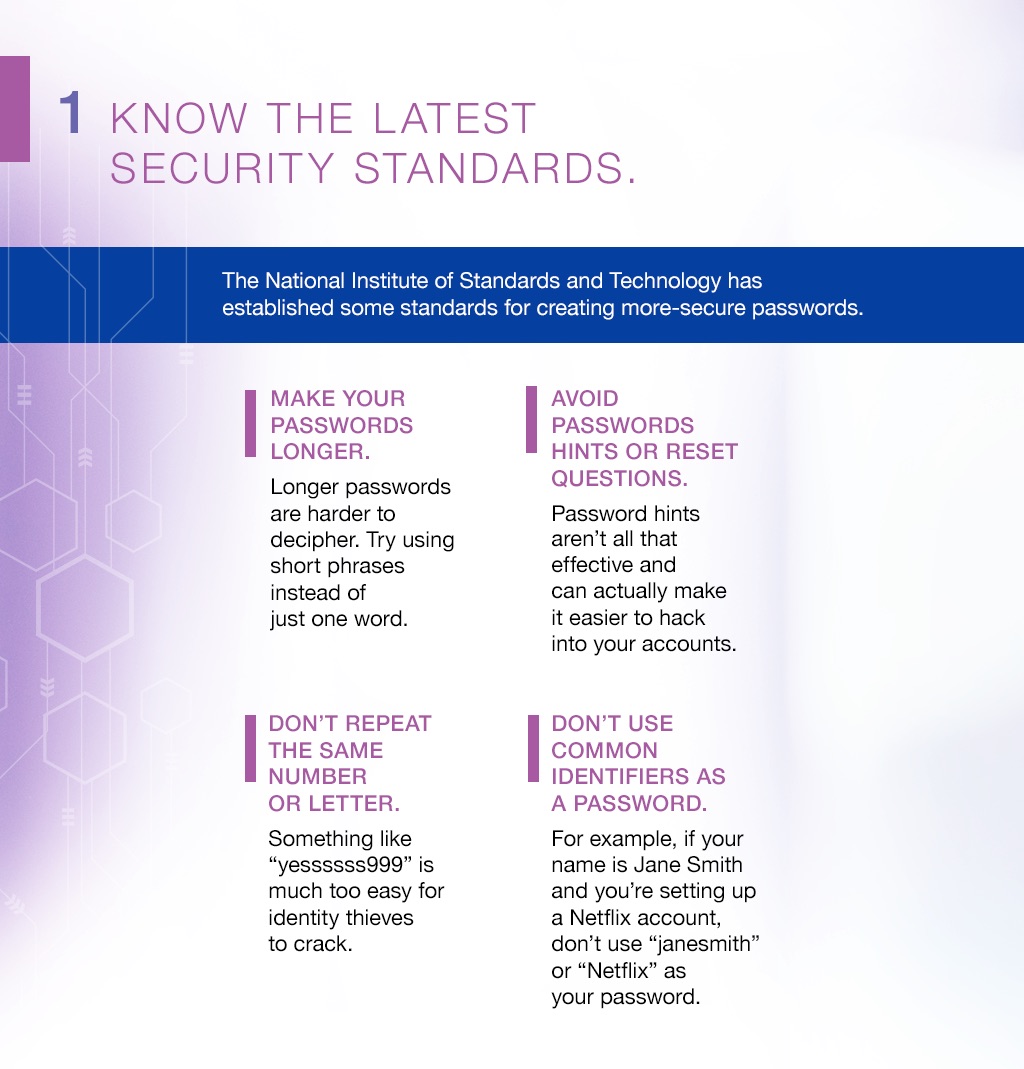
A great password is often the only thing standing between you and identity theft. But what makes a password really secure? Turns out, there are some important guidelines to follow to keep information safe. Read on for three smart tips.1. Know the latest  security standards.The National Institute of Standards and Technology has established some new rules for setting more-secure passwords.MAKE YOUR PASSWORDS LONGER.Longer passwords are harder to decipher. Try using short phrases instead of just one word.AVOID PASSWORDS HINTS OR RESET QUESTIONS. Password hints aren’t all that effective and can actually make it easier to hack into your accounts.DON’T REPEAT THE SAME NUMBER OR LETTER.Something like “yessssss999” is much too easy for identity thieves to crack.DON’T USE COMMON IDENTIFIERS AS A PASSWORD.For example, if your name is Jane Smith and you’re setting up a Netflix account, don’t use “janesmith” or “Netflix” as your password.2.Don't use the same  password more than once. By using the same password on multiple services, you are potentially giving hackers access to every service where you're using that password. This is like having a single key that opens your house, your, car, and your bank's safety deposit box. If someone steals that key, they can access everything you own. Always create different keys, or passwords, for separate accounts.3. Make use of a  password manager. A password management tool is your greatest ally. These are  programs or apps that will create unique passwords on each of your accounts and store them all for you in a single, secure location, so you'll never lose them again. They can also sync with multiple devices and  auto-populate passwords whenever you need them, saving you a ton of time and trouble. The World Wide Web can be complicated,  but setting secure passwords doesn't have to be. With a bit of effort, you can use smart practices to help keep all your accounts safe and secure. SOURCE: The National Institute of Standards and Technology, 2019
 

Related Content

Medicare Advantage 101

Medicare Advantage 101

Overview of Medicare Advantage, what’s in them, special rules, and more.

U.S. Personal Savings Rate

U.S. Personal Savings Rate

What can be learned from the savings rate?

The Facts About Income Tax

The Facts About Income Tax

Millions faithfully file their 1040 forms each April. But some things about federal income taxes may surprise you.


Have A Question About This Topic?


Thank you! Oops!

What Do Your Taxes Pay For?

Here's a breakdown of how the federal government spends your tax money.

How Retirement Spending Changes With Time

It can be difficult for clients to imagine how much they’ll spend in retirement. This short, insightful article is useful.

A Path to Serenity and Smart Money Choices

An article about meditation, mindfulness, and financial well-being.

View all articles

My Retirement Savings

See how your current savings rate and contributions may grow into retirement income.

Comparing Mortgage Terms

Compare different mortgage term lengths side by side to find the option that fits your budget.

Social Security Tax Estimator

Estimate how much of your Social Security benefit may be subject to federal income tax.

View all calculators

Should You Tap Retirement Savings to Fund College?

There are three things to consider before dipping into retirement savings to pay for college.

Choosing a Mortgage

Selecting a mortgage isn't an easy process. Get a better understanding of how professionals make the right decisions.

18 Years Worth of Days

The average retirement lasts for 18 years. What will you do with your days?

View all videos